
How Fight Club's Screenplay Turns a Novel into Cinema
Updated
 Priya.VEditor
Fight Club begins by giving its audience a problem: the person telling the story is entertaining, articulate and not a dependable guide to what is happening. For screenwriter Jim Uhls, adapting Chuck Palahniuk's 1996 novel meant more than reproducing incidents or dialogue. A film needs to show what a reader can imagine privately, while also hiding information that becomes crucial later. David Fincher's 1999 film turns those competing demands into its engine. This article examines the screenplay's construction, not a scene-by-scene inventory of changes from book to film, which deserves a separate comparison. Spoilers follow, including the central identity revelation.


Why the first-person voice cannot simply be photographed
Palahniuk's story relies on the intimacy and limitations of a first-person narrator. On the page, repeated observations can create a mind through rhythm and emphasis. Film has another problem: the audience watches an actor move through actual rooms, encounters other people and may take what the camera shows as independent evidence. If the adaptation merely photographed conversations, the narrator's distinctive experience could disappear. If it explained every inner thought in spoken commentary, the image would become subordinate to a lecture.
Uhls chose a voiceover that behaves like an active participant in the scene. It can be sarcastic, self-excusing or sharply different from the behaviour it accompanies. The screenwriter explained in a retrospective interview about his own adaptation that the challenge was to create the experience of reading the novel, which did not necessarily mean reproducing its exact incidents. That principle is visible throughout the film: voice and image can agree, contradict or reveal different amounts of truth.
The opening makes an ending feel like a question
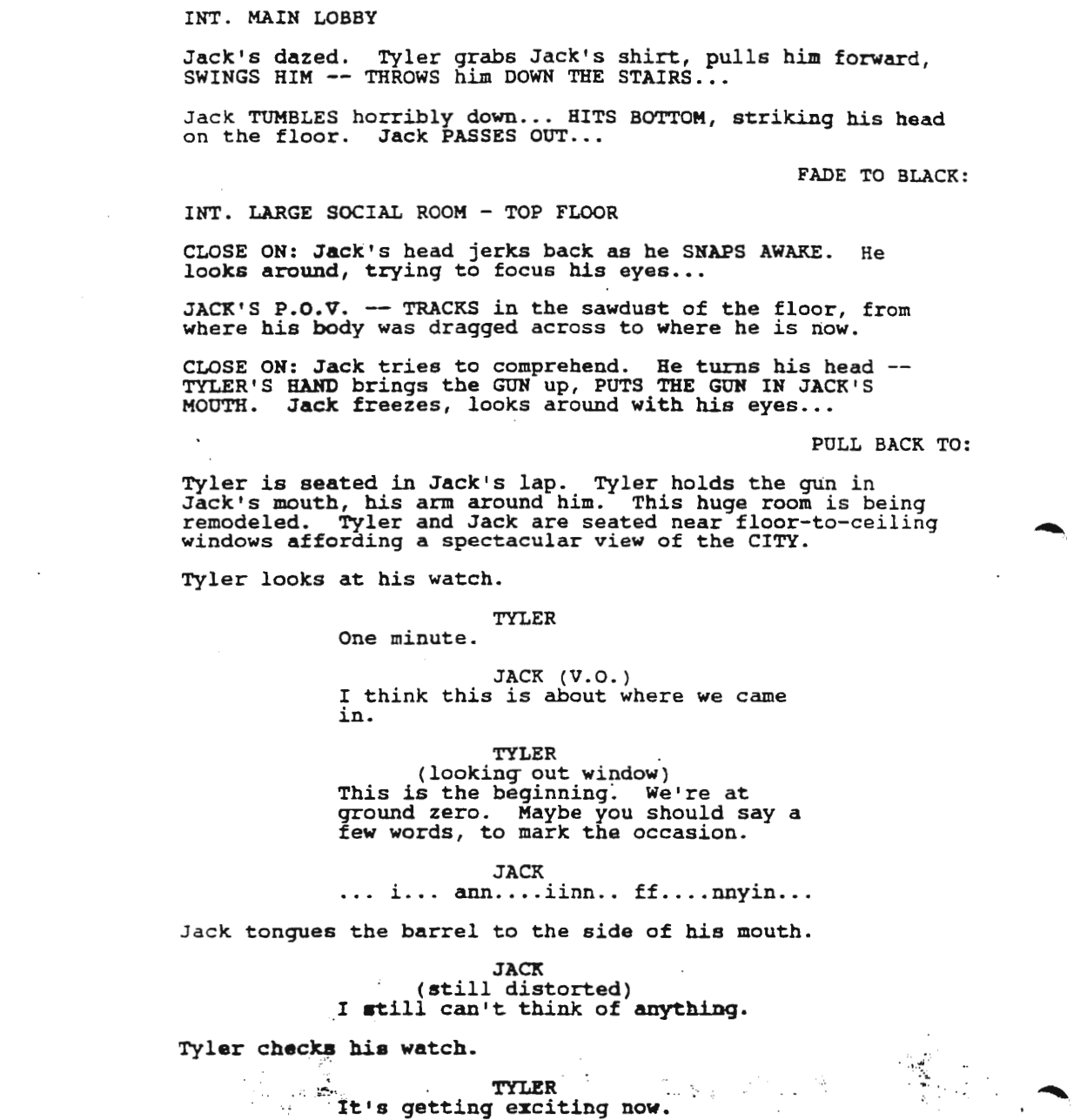
Beginning near the apparent climax places the audience inside immediate danger before providing enough background to explain it. The narrative then moves backwards through the everyday routine that makes the encounter possible. Rather than treating the opening as a simple trick, notice the change in what viewers want to know. Initially the questions concern a weapon, a building and two people. As the film progresses, they concern the narrator's identity, the credibility of his memories and how he became involved with a movement he can no longer control.
This arrangement creates two distinct kinds of suspense. One is mechanical: how can the story return to the opening situation? The other is interpretive: what has the narrator misunderstood about his own life? The latter is stronger because it survives knowing the plot. On a second viewing, the opening has become an expression of his predicament rather than a promise of a spectacular action scene. A clever structure earns its place when the meaning changes after the first viewing.
Turning Tyler from an introduction into an authority
Tyler Durden has to be persuasive enough that both the narrator and much of the audience initially follow him. Uhls described a particular adaptation problem: transferring the film's apparent authority away from the narrator and towards Tyler. The meeting between the characters therefore performs several functions. It interrupts the narrator's routine, offers a new kind of companionship and presents a competing explanation of dissatisfaction. The audience has heard the narrator judge everybody; now somebody else seems confident enough to judge him.
Brad Pitt's performance contributes enormously, but the screenplay prepares the transfer. The narrator is exhausted, judgemental and short of believable alternatives. Tyler enters with a coherent-sounding language of escape. The writing avoids providing an immediate formal rebuttal to every assertion. That is not evidence that the film endorses Tyler. It is the mechanism by which a seductive argument becomes dangerous. A viewer needs to understand its attraction before watching the damage done in its name.
The support groups establish an emotional contradiction
Before underground fighting becomes the apparent answer, the narrator attends support meetings and experiences a form of connection. These scenes are easy to remember only as uncomfortable comedy. Dramatically, however, they establish what his ordinary life lacks: occasions on which he can stop performing competence and be emotionally visible. Marla's arrival threatens that arrangement because her presence reminds him of his own dishonesty. The conflict exposes his need to feel exceptional even in a situation built around vulnerability.
The screenplay therefore gives fighting a predecessor. Both the meetings and the club are rituals through which people seek relief from isolation. They differ profoundly in how participants treat one another and in what the group demands. This comparison matters later when participation turns into obedience. The story is not simply about a bored employee choosing violence; it is about a man repeatedly seeking a place where a version of himself will be accepted, then accepting increasingly damaging conditions to preserve it.
How unreliable narration becomes a fair dramatic device
A revelation about identity can feel dishonest if the screenplay has concealed ordinary facts only to surprise the audience. Fight Club uses a more demanding strategy. The viewer is shown a subjective account and is encouraged to treat its presentation as normal. The film's behaviour, awkward conversations and shifts in how other characters respond become more meaningful once the central revelation is understood. The story does not need a separate detective figure announcing every discrepancy.
The distinction is between what a character genuinely experiences and what can be independently established. The narrator's internal certainty is not evidence of an external person. Once that difference becomes clear, scenes previously read as friendships or arguments become conflicts within a single identity. The drama remains morally serious: an unreliable perspective does not eliminate the consequences of actions taken in the world. It changes how responsibility and denial are understood.
The rules of the club gradually reveal their price
The screenplay's early rituals have an appealing simplicity. A private gathering offers direct physical confrontation and apparently eliminates familiar social ranks. But the language of shared liberation increasingly becomes the language of command. The transition towards Project Mayhem does not arrive from nowhere. It grows out of participants accepting a leader's rules, repeated obedience and the idea that individual hesitation is evidence of weakness. The structure makes escalation legible without suggesting that a political or psychological problem can be solved through harm.
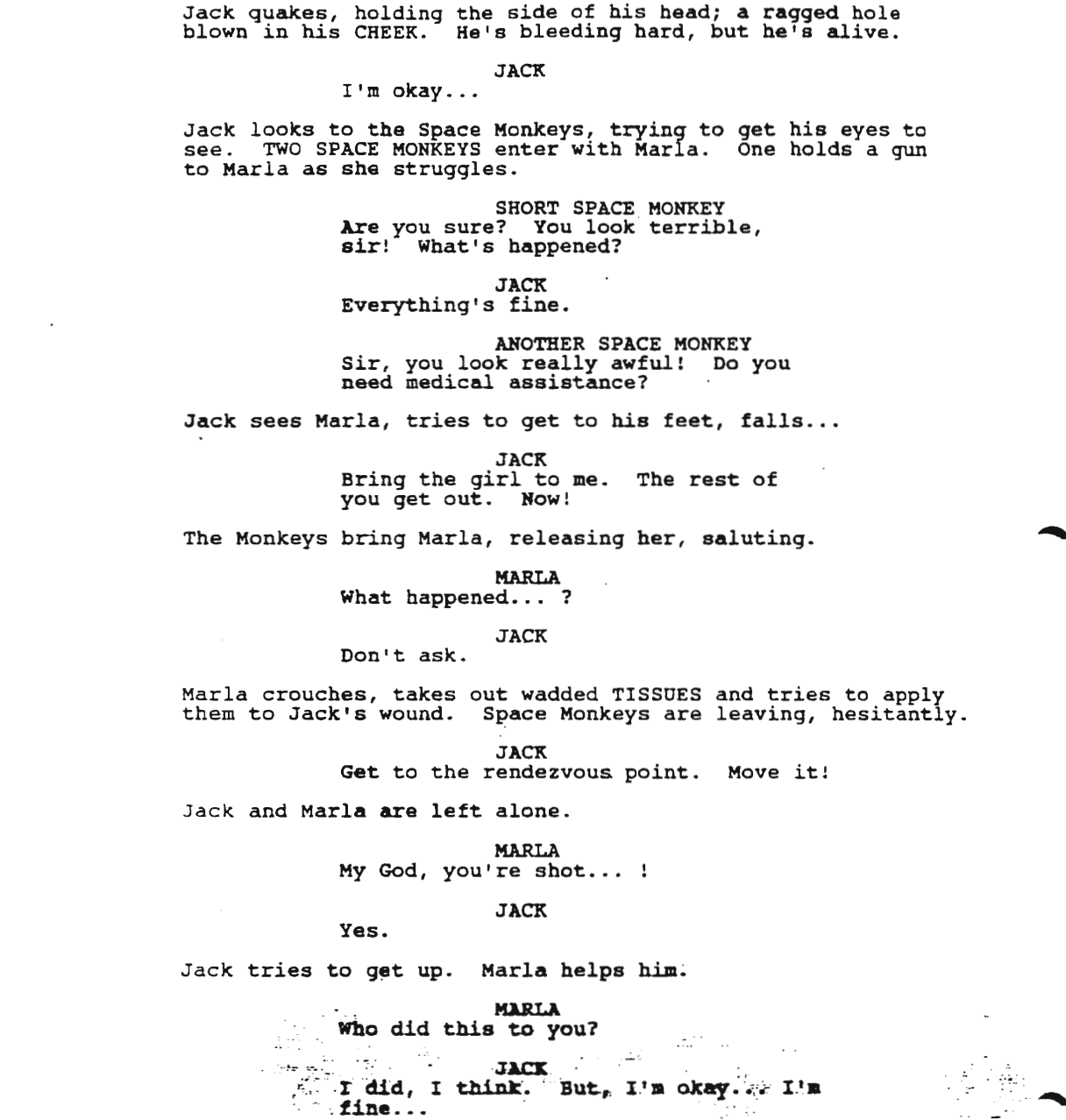
Robert Paulson's story is especially important as a test of the group's supposed concern for its members. An individual whom the narrator knew as a person becomes a symbol repeated by others. The emotional loss reveals how a movement can claim to celebrate humanity while reducing a person to a useful slogan. The writing lets the organisation's response expose its contradiction. This is more effective than a detached speech about the dangers of extremism because the audience has watched the relationship develop.
Why the final act must answer an emotional question
Once the narrator recognises Tyler's nature, the screenplay cannot depend solely on keeping the secret. The final movement instead asks whether he can take responsibility for what has happened and relate honestly to somebody outside his self-created mythology. Marla matters because she is not simply another audience for Tyler's speeches. Her presence demands a relationship in which the narrator cannot control every role. The ending is deliberately unsettling, and the physical danger should not be confused with a realistic treatment or solution for mental illness.
A screenwriting lesson emerges from the progression. The opening supplies intrigue, the middle teaches the audience to follow an unreliable guide, and the end changes the problem from revelation to accountability. The AFI credit record establishes Uhls, Fincher and Palahniuk's novel as the screenplay's production context; the studio's film page confirms the work's identity. Watching the film again with a single question in mind is useful: which scene makes the narrator more aware of the outside world, and which gives him another excuse to retreat into Tyler's story? That conflict is the adaptation's real dramatic spine.
What changes when a story is told as voice or action?
Uhls's adaptation can be studied through two different kinds of information: the narrator's private account and the behaviour the audience can observe. These are dramatic functions, not claims that every scene uses one technique exclusively.
| Task | Narrator's voice | Visible action |
|---|---|---|
| Establish routine | Expresses contempt and fatigue through phrasing | Shows travel, work and an organised living space |
| Introduce Tyler | Filters the encounter through fascination | Lets another performer command the exchange |
| Create uncertainty | Asserts a version of events with confidence | Allows other characters' reactions to complicate that account |
| Show belonging | Describes emotional relief in subjective terms | Reveals rituals and the consequences of participation |
| Reach the revelation | Must reassess an earlier self-description | Allows previously familiar encounters to gain a new meaning |
Interpretation: On a repeat viewing, follow the gap between a confident description and what another character actually does. For the adaptation's first-person challenges, read Uhls's first-hand account (voice side); for the visible film and screenplay credits, consult the AFI film record (action side). These are qualitative observations, not a numerical comparison.